
AMPS Penalties
Administrative Monetary Penalty System (AMPS)
Some of the challenges of the Administrative Monetary Penalty System (AMPS) are both the procedural fairness of the system and administrative-law avenues to challenge the AMPS fines. Where the municipality failed to give meaningful notice, potentially failed to identify the alleged offence that occurred in respect of the bylaw and associated sections then the ticket may be invalid. Identifying the offence with sufficient particularity is vital. As is the need for the town/city to provide appeal information, the resident needs to option to appeal.
At minimum, you should assess whether the tickets/penalty notices are invalid or voidable, whether there is a statutory reconsideration/appeal route, and whether judicial review or a motion to set aside/reopen the penalties is available on fairness grounds.
Failure to provide appeal information
Any municipality administering an AMPS regime must generally act fairly and transparently. Procedural fairness requires, at a minimum each of the following:
- adequate notice of the case the residenmt must meet,
- a meaningful opportunity to be heard through a screening hearing or other tribunal,
- an unbiased decision-maker, and
- in higher-impact matters, reasons and process protections suited to the consequences.
If the municipality did not tell your client how to appeal or challenge the fines, that can support an argument that the process was not meaningfully fair, particularly where the penalties are “massive” and therefore high-impact.
Failure to Identify the Offence properly
If the municipality ticketed the resident with the offence of having “too many dogs” on the property. If the bylaw officer failed to identify each of the dogs with sufficient specificity, e.g. names, breed, description, etc., it is similar for other AMPS offences. One key question that Invictus Legal LLP will look at is whether the relevant act, bylaw, and sections. That may amount to a defective notice being provided by the municipality.
Further the rules of procedural fairness require that enough information for the affected person to understand and respond to the allegation be made by the bylaw officer. Failure here can void the ticket.
That issue is especially important where:
- multiple dogs are involved,
- ownership/possession is disputed,
- the bylaw limit depends on how and whether particular animals are counted,
- or the municipality’s allegation is vague enough to prevent the resident from making a valid defence.
As each municipality has different bylaws Invictus will assess your situation in providing valuable assistance.

Failure to Identify the Issues properly
In the above example the municipality ticketed the resident for “too many dogs” but failed to identify the dogs with sufficient specificity, that arguably amounts to defective notice, per Section 44(10). While under Section 44(12)), failure to give notice is not fatal if the municipality is not prejudiced in its defence. Procedural fairness requires enough information for the affected person to understand and respond to the allegation.
That issue is especially important where:
- multiple dogs are involved,
- ownership/possession is disputed,
- the bylaw limit depends on whether particular animals are counted,
- or the municipality’s allegation is vague enough to prevent a real defence.
In respect of the given example if there are too many dogs, it is logical that the Bylaw officer would take regular trips to count the dogs, particularly if the home owner notifies he muniocipality of the step to compliance. There is well-established Canadian case law that defective notice can render an administrative or quasi-penal process unfair and, in some circumstances, invalidate the resulting decision or penalty.
The Magnitude of the penalty Matters
The greater the financial and practical impact, the more robust the fairness owed by the Municipality. Massive penalties can justify stronger process protections, including:
- clearer disclosure,
- a proper hearing,
- meaningful reasons,
- and potentially a more generous approach to time limits or reopening if the affected person was not told how to appeal.
Remember some penalties can extend to thousands of dollars.
Practical options
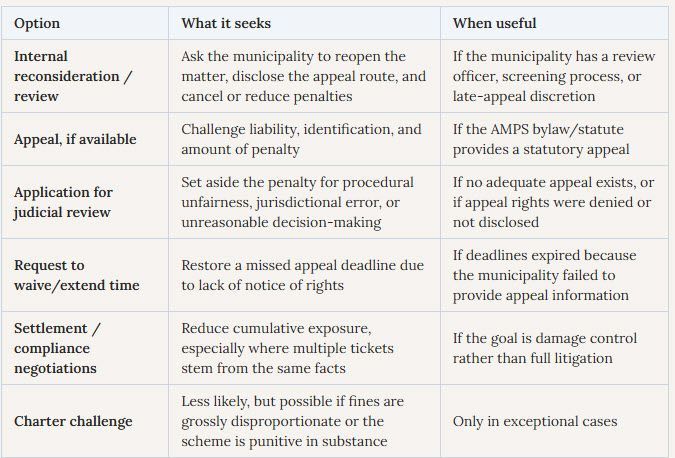
In order to help you Invictus Legal LLP needs you to bring all relevant documents to your initial concultation.
Any municipality administering any Administrative Monetary Penalty System (AMPS) regime for bylaw offences must act fairly and transparently.
The AMPS ticket or summons should properly the alleged offence, the corrective measures the homeowner can apply, and how to get a screeing hearing.
Procedural fairness is critical for all administrative-law avenues to challenge AMPS fines. Of concern is the situation where the municipality failed to give meaningful notice, failed to identify the offenbces committed. One indication of the need for proper identification is where a homeowner is accused of having too many dogs. Writing tickets that fail to properly identify the dogs with sufficient particularity, and does not provide any appeal information, lacks procedural fairness. At minimum, anybody given a ticket or penalty notices are invalid or voidable. There must be a statutory reconsideration option or appeal route that the ticketed person can request their case be reviewed. The municipality must provide the ability for a motion to set aside/reopen the case with the penalties is available on fairness grounds.
Failure to provide appeal information
A municipality administering an AMPS regime must generally act fairly and transparently. Procedural fairness requires, at a minimum each of the following:
- adequate notice of the case to meet,
- a meaningful opportunity to be heard,
- an unbiased decision-maker, and
- in higher-impact matters, reasons and process protections suited to the consequences.
When the municipality did not tell the resident how to appeal or challenge the fines imposed, that can support an argument that the process was not meaningfully fair. This is particularly true where the penalties are “massive” and therefore high-impact, such as $1,000 per incident.
Call Invictus Legal LLP today to see if your ticket is challengable.
For more information look at our video:
Spin Legal