

Landlord Rights in Ontario
Directory of Services for Landlords
If you are a landlord in Ontario, Invictus Legal LLP offers practical, cost-effective legal services tailored to the challenges and responsibilities of residential landlords. Whether you are dealing with a difficult tenancy, seeking advice before taking action, or navigating the complexities of the Landlord and Tenant Board process, our experienced team is here to guide you with clear advice, responsive service, and effective representation every step of the way.
As we represent both landlords and tenants, this gives our team a balanced understanding of the rights, obligations, and practical issues that arise under Ontario's residential tenancy laws. This broad experience allows us to provide informed, practical advice while remaining focused on achieving the best possible outcome for our landlords. Our landlord services are delivered by experienced paralegals who regularly assist residential landlords with matters before the Landlord and Tenant Board.
We primarily work with small and independent landlords—typically those who own between one and fifty rental units. Whether you have a single investment property or manage a growing portfolio, your rental properties are an important investment which will help you grow your wealth. Your rental properties are a business. Sadly disputes can have a significant financial impact on your rental business. We provide clear, practical guidance on tenancy issues, help landlords comply with their legal obligations disctated by the Residential Tenancies Act. Invictus represents clients through the Landlord and Tenant Board process and across the whole of Ontario from Windsor to Ottawa and from Fort Erie to Pickle Lake in northern Ontario.
Our goal is to resolve problems efficiently, protect your investment, and provide you the confidence that experienced legal professionals are advocating on your behalf.
The Ontario Standard Lease
The relationship with the tenant starts when you hand them the key. Today, Ontario landlords are required to use the Ontario Standard Lease when entering into most new residential tenancy agreements. This requirement was introduced because many of the leases previously used by landlords contained provisions that were unclear, unenforceable, or inconsistent with Ontario's residential tenancy laws. These leases were often not valid, legal leases, which can was problematic for some landlords.
For landlords, using the correct lease is more than a legal requirement—it's a practical way to protect your investment property. An improperly drafted lease can create unnecessary disputes, make enforcement more difficult, and lead to costly proceedings before the Landlord and Tenant Board. Because the LTB has exclusive jurisdiction over most residential tenancy disputes, including the termination of tenancies, the validity and wording of a lease was in the past a significant issue during hearings. In the past, adjudicators were often required to determine whether a lease was legally enforceable before they could even address the underlying dispute.
In 1230455 Ontario Ltd. v. 150 Katimavik Inc. (2019), courts stated that the standard lease terms will apply to all occupants based on an offer and actual occupancy, even if the formal standard form was not fully signed by both parties, in other words acceptance is deemed by the action of the parties.
The Ontario Standard Lease was designed to protect both landlords and renters by making rental rules fair, clear, and easy to use. It created a clear, and consistent framework considering the needs of both landlords and tenants. It establishes standardized terms, clearly outlines the rights and responsibilities of each party, and reduces confusion about what is and is not permitted under Ontario law.
By implementing a single standard lease across Ontario the government simplified the issue of lease validity and allowed the Board to focus on real tenancy issues. Essential services for Ontario landlords include some legal clinics, regional landlord associations, property management companies. Additionally landlords will use many tenant screening tools, maybe they belong to Facebook groups what discuss the question of being a strong landlord. Key organizations provide guidance on the Residential Tenancies Act, dispute resolution, and daily operations and how they impact the average landlord in Ontario.
Custom clauses can be added to the standard lease, however any custom clause in the lease that contradicts the RTA standard is automatically void, so even if you add a clause the LTB adjudicator can interpret its use.
At Invictus Legal LLP, we regularly assist landlords in reviewing their leases, thus ensuring compliance with Ontario's residential tenancy laws, and addressing lease-related disputes before they become an expensive legal problem.
For the new Landlord
If you are a new landlord, then you need to be aware that the Landlord and Tenant Board (LTB) manages all disputes between landlords and tenants. If you wish to evict a tenent then this must be handled properly via the LTB. The LTB is governed by stututory rules and is managed by Tribunals Ontario.
As a new Landlord you may need added advice. There is a lot of information available from local landlord support groups. on useful place to visit is the
Landlord's Self-Help Centre. They are a specialty legal clinic providing education and summary advice for small-scale landlords. They are a non-profit specialty community legal clinic funded by Legal Aid Ontario, as with all legal aid services in Ontario, whether you can use their service will depend on your earnings.
Thare are a variety of things a new landlord needs to know. You can only collect rent for the current rental period. A rental deposit equal to one month’s rent (or rent for one rental period, whichever is less) must be used as the last month's rent, any other amount is illegal. Be aware that damage and pet deposits are illegal in Ontario. The Law states that you must maintain the property to meet all health, safety, and housing maintenance standards as defined by your local municipality.
Furthermore, you are not permitted to change locks, cut off utilities, or remove a tenant's belongings without an order. Evictions require a formal order from the LTB enforced by a court sheriff. Rent can only be raised once a year and must be limited to the guideline rent (for older properties). You can find the rules and rates for guideline rent increaes at the Ontario website.
Please be aware that some cities, like Thorold, require Landlords to obtain a
license for residential rental properties.
Haldimand County, Brantford, Caledonia
This is such a beautify part of our province, yet Lanlords do face challenges of collecting rent, Tenant damages, maintenance, etc. This is where the Paralegals at Invictus can help.
Guelph, Kitchener, Waterloo, Cambridge
Every city has homes to rent, this is where Invictus Legal can help you as the Landlord. we can assist with negotiations. we seek to resolve any tenancy problems you face.
Windsor, Essex, Chatham Kent
Invictus has Landlord clients in Southwest Ontario. and is available to assist with all of your landlord legal assistance. Having on-line hearings means that the legal teams are not limited geographically.
Landlord Services
Invictus Legal has helped clients with a range of services, including:
- Evictions for non-payment of rent.
- Annual rental increases following legal guidelines.
- Above guideline increases to rent when specific conditions apply.
- Rent arrears agreements to bring tenants that are in arrears up to date and ensure they continue to pay rent on time and every month.
- Enforcement when Tenants fail to adhere to an agreement.
- Negotiated an exit strategy when the Landlord wishes to re-occupy the rental unit.
- Stoped tenants being a nuisance, disrupting others, or causing damage to the property.
- Evictions for illegal acts committed by tenants.
- Non payment of utility bills.
- When a landlord needs to change the use of the rental unit, e.g. from residential to commercial.
- Ensured the right legal steps were taken when landlords sell their investment property. Invictus works with realtors and conveyancing solicitors to ensure the right contract is formed.
- Ensure the right legal steps are taken for renovation, rebuilding and demolition of the property.
Eviction for Non-Payment of Rent
The basic requirement for most landlords is to evict non-paying tenants. This action is managed under the the Residential Tenancies Act, 2006 (RTA), through Sections 59 and 69.
Section 59 defines the rules for the use of the N4 notice, while Section 69 defines the rules for the associated L1 eviction application. These are the key elements of the act governing the eviction of tenants for non-payment of rent. The LTB interprets these rules alongside Interpretation Guideline 11 (Rent Arrears) and discretionary relief principles under Section 83 of the RTA. The N4/L1 evictions in Ontario are not governed by a single landmark court judgment, but rather by statutary rules and regulations.
Furthermore the law allows some discretionary relief including a wide scope of tenant rights issues, which need to be looked at by the landlord, such as enjoyment of the property and maintenance.
Foe an eviction to be successful the N4 Notice must be correct on its face and served in the authorised manner. Applying to the Board for an eviction for non-payment of rent is given a higher priority than other applications to the LTB.
Bill 60 and Bill 97 Implementation
After September 21st 2026 the LTB rules changed
As of this date, the RTA has been updated to include the changes related to both Bill 60 and Bill 97.
For an N4: Notice to End Tenancy Early due to Non-Payment of Rent, what this means is that the notice period for an is shortened from 14 to 7 days. On the 8th day after non-payment, the landlord may make an application to the Board, using the L1 form. The aim is to shorten the time before a hearing.
Late Payment is a Conduct issue
Tenants Persistently late Paying Rent - N8
At Invictus Legal LLP we have evicted a tenant who was up to date with their rent, yet had persistently paid their rent late. For some tenants paying rent on time is a game. There is a remedy available to the Landlord when a tenant repeatedly fails to pay rent on the due date, normally the 1st day of the month. Updated regulations that are a part of the RTA have established a standard threshold of 3 late payments within a 12 month period.
The new rules are governed by O. Reg. 241/26, which regards persistent failure to pay on time as:
Persistent failure to pay rent on the date due
8.1 (1) For the purposes of paragraph 1 of subsection 58 (1) of the Act, a persistent failure to pay rent on the date it becomes due and payable includes circumstances in which a tenant has failed to pay rent within seven days of the date it becomes due and payable on at least three occasions within any six-month period and on each of those occasions the failure to pay was not solely attributable to the landlord applying a rent payment made during that six-month period to another amount owing by the tenant, including rent arrears.
(2) For greater certainty, a persistent failure to pay rent on the date it becomes due and payable may arise in circumstances not set out in subsection (1) and the circumstances set out in subsection (1) shall not limit what may constitute a persistent failure to pay rent on the date it becomes due and payable.
Timing is critical, the landlord must give at least 60 days of notice (or 28 days for a daily/weekly tenancy), and the termination date must match the final day of the rental period or lease term. When the N8 is served the termination date on it must not the the last day of the rental period, e.g. June 30th.
New
If the tenancy is for a fixed term (for example, the first year of the lease), the termination date specified cannot be earlier than the last date of the fixed term.
Remember when the disagrees with the notice they do not have to move out. However, the landlord can apply to the Board to evict the Tenant within 30 days of serving the N8 on the tenant. The Board will schedule a hearing where you can explain why you disagree. You must be prepared for a Board Hearing.
If the tenant moves out and returns the keys, or leaves them in the rental unit, before or on the termination date then the tenancy is therefore terminated. The Landlord is then in full possession of the rental unit.
If you need more information email angela@weareinvictus.legal or peter@weareinvictus.legal or call Invictus Legal LLP on 905-688-5598.
Defending Against a Tenant Application
The Act also allows Tenants to file applications against a landlord, when this occurs the landlord will receive either by email or though the postal system a notice of an application filed against you. The information you will receive from the LTB will include a PIN number. You may also receive a Notice of Hearing for an upcoming hearing date, when this happens understand how much time you have till the hearing or Adjudicative Case Conference.
The most common applications the Landlord will receive are:
- A Tenants Rights Application, or.
- An application relating to maintenance problems in the rental Unit.
The Tenants Rights application can cover a number of areas, including:
- Illegal entry to the rental unit, where the proper 24 hours notice is not given.
- Harrassment of the tenant or their guests.
- improper deductions, that can include witholding deposits without justification.
- Serious repairs of maintenance issues that affect the health, safety, or privacy of the Tenant.
- Removing a parking space.
Maintenance applications (T6) can be wide ranging, which is one reason you should ensure that your rental units are in a good state of repair.
Some such applications arise because the Landlord has issues an N4 or N5. Then the cause of the tenent's issues are the black molk that never existed before. Whole the law stops landlords from retaliating when a landlord makes a complaint, this rule does not seem to applyt to tenants.
Review the Notice of Hearing
You should prapare well in advance of the hearing, and you should consider representation by a firm like Invictus Legal LLP in praparation for that hearing. If you have representation you should engage them at the earliest opportunity. If you arrive at the LTB hearing without representation then it can disadvantage you as the Landlord. While their are many paralegal firms available to assist the landlord, options like legal aid are not generally available for landlords. You can discuss your problem with the Landlord Self Help Centre, their mandate is to provide support to Ontario’s small landlord community, but they do not provide representation.
Gather your evidence against the Tenant, you will get an opportunity to give your viewpoint at the hearing. You will have the opportunity to share your evidence to the Board, the evidence is your oportunity to demonstrate your side of the story. Just because the tenant made a complaint doesn't mean they are right or will be believed at the hearing. The hearing relies on solid evidence, which includes documents, video, pictures, text messages and other material.
Download and understand the allegations the tenant has made. Think about whether an alternative solution is possible. Get some legal advice about the best response to make. Sometime the bast result means making a payment to the tenant. Just because you make a payment does not mean you are admiting you did anything wrong.
Ball v. Metro Capital
The case of Ball v Metro Capital 2002 is a Divisional Court ruling that set the legal standard for eviction notices. Notices like the N5, N6, N7 and others must be specific. Allegations must include dates, times, and a detailed description of the alleged behavior, who performed the activity, to the best of your knowledge. Talk to others affected by the tenant's actions before issuing the notice, this is the time you should seek legal advice.
The principle allows the tenants to understand the case against them, and fix the issue within the seven day period provided.
For the N1 / N4 / N9 the rent amount, arrears period, termination date, and payment details must be stated accurately and cannot be misconstrued.
In N5 / N6 / N7 notices, allegations like interference, damage, or overcrowding must be fully explained. Where is the damage? how did it occur, to the best of your knowledge? These are the types of questions that the Tenant of the paralegal will ask in the LTB hearing. Further for allegations of illegal acts stating that strange people are hanging about the building on their own are not proof of drug dealing.
Ontario’s eviction system is notice-driven. In the notice a tenant must know, what conduct or ground is alleged, when it occurred, what statutory basis is being invoked, and what the tenant can do to cure, dispute, or prepare a defense.

Niagara Region
Invictus Legal LLP offers landlord services in the Niagara Region. We have dozens of repeat Landlords in the region where the firm is heaquartered. Special attention needs to be paid to Thorold, ask our team why.
Clients include landlords in Fort Erie, Niagara Falls, St Catharines, Welland, Port Colborne, and Niagara on the Lake.
Hamilton, Burlington, Oakville
With the Landlord and Tenant Board we are able to represent landlords across Ontario, including Burlington, Oakville and Hamilton. Inviuctus assists with each of these cities.
It is your rental unit that you are protecting, Give us a call.
Toronto, Etobicoke, Mississauga and the GTA
You own a home in Toronto or the central part of the GTA, then Invictus Legal LLP has paralegals who can assist. Toronto, North York, Scarborough, and Markham are among the biggest housing markets. If you have rental unit their we can help.
how Invictus Legal can help you use N5, N6, N7 and L2 Applications to remove troublesome tenants
Landlord Notices made for Tenant Conduct
There a a lot os ways to use an L2, conduct based application. There are many ways this type of application can be used to evict a Tenant. Did you know that a Landlord can evict a tenant that is up to date on their rent? The reason this is possible is because of past tenent conduct.
Issuea like undue and excessive noise, cause damage in the rental unit, having loud parties that disturb the neighbourhood late into the night, each and every night. You do this by using N5, N6 or N7 notices. Use of such notices should not be taken lightly, the offence committed should be serious. So the music palyed till 11 minutes past 11 on the 13th of June, is not alone necessarily enough to evict a tenant for bad conduct.
The N5.
A single N5 notice where the tenant does not repeat the offence should not lead to the filing of an L2 with the LTB, because the tenant is always able to void the notice through corrective action.
An N5 should only be issues because of a serious issue, not for minor infractions of the rules. Serious issues include, substantial interference with the enjoyment or rights of others. The LTB adjudicator must consider whether the disturbance was eccessive of disruptive, such as slamming doors, loud music, actine in an agressive way to others. This can include smoking in areas where smoking is prohibited and others issues where the Tenant interfers with another person's lawful rights.
Key LTB Case Law in respect of N5 Substantial Interference
- Northview-Apartment-REIT v. Al-Mashhadani (2021): for an N5 served on the tenant where at the LTB hearing the landlord provided uncontested proof of ongoing, excessive noise that disrupted other residents in the building. The case showed that a documented pattern of complaints over time outweighs a tenant's claim of normal living sounds immediately after the N5 was served.
- Symphotech Consulting Inc. v. Tousignant (2021): The Board ruled that late-night disruptive behavior—such as intentional stomping, banging, and hammering on water pipes—actually constitutes substantial interference with the reasonable enjoyment of the residential complex.
The substantial interference test is a foundational threshold requirement in common law that has developed over time. it is relevant to both rental housing and problems within residential neighbourhoods. It is "substantial" when it amounts to significantly more than a slight inconvenience, trifling annoyance , or petty grievance and is defined by the reasonable person standard, as defined in the English common law case, Vaughan v. Menlove (1837).
Property Damage and Overcrowding
Property damage is one reason for an N5 notice to be made. The damage caused may be solely within the rental unit, in the building or other damage around the rental complex.
Overcrowding the rental unit is another reason for eviction. the definition here is where the number of people living in the rental unit exceeds the maximum permitted by local health and safety or property standards. The tenants having a guest family over for the weekend is not sufficient. To succeed on a claim of overcrowding the issue must be long term.
With an N5 the Landlord should new file an L2 application once the 14th day has passed. They need to check whether the offence is recurring. The majority of such offences are made by mistake, perhaps a moment of anger and the Tenant does not re-offend.
Re-offending after an N5.
When a tenant re-offends within six monthe then Lhe landlord may issue a second N5 . With the first N5 the Tenant can take action to fix the problem, with the second N5, this option does not exist. Even if the tenant immediately ceases their behavior or repairs the damage caused having received the second notice, the notice remains valid, and the eviction process continues. Here the Landlord has a limited time to file the L2 application and go to a hearing at the Board to requests the Tenant's eviction.
Understand, the first N5 requires a minimum 20-day termination notice period, while the second N5 (the re-offence): Requires a minimum 14-day termination notice period. Then the L2 application must be served within 30 days of the date the notice is served.
Illegal Acts, the N6
The N6 notice is not voidable, and the Tenant is given a 10 day notice period
The N6 Notice: Protecting the Safety and Integrity of Your Rental Property
The N6 Notice has multiple uses, the most common being as a method to evict a tenant because of illegal use. It is a serious enforcement tool available to the Ontario Landlord. Its purpose is not simply to address a tenant's breach of the tenancy agreement, but looks at the circumstances which the tenant (or a member of their household) allegedly committed. Allegations of drug related crimes (trafficking, manufacturing, or possession is a common allegation. Illegal businesses is another allegation), this has also included allegations of sexual abuse - therefore impacting the safety of another tenant.
The important factor here that illegal acts do not have to be proven in the criminal court before the allegation is raised against a tenent, also, importantly, understand an application based on an N6 notice is not a criminal prosecution. The Tenant is not automatically guilty. The landlord does not have to wait for a criminal conviction before taking action.
Most people agree committing dangerous or unlawful acts in or around the rental unit can jeopardize the safety, security, or legal rights of the landlord, other tenants, or neighbors and can in the most severe of circumstances be actionable. In the most severe of circumstances the police have powers to evict a tenant for illegal acts. In one instance a neighbour reported a strange smell to the police, who monitored the apartment to discover a drug lab and subsequently jailed and evicted the Tenant. Generally this requires a proveable criminal case. Not all N6 applications rise to that level of severity, also remember the LTB does not make judgement based on criminal burden, but based on civil rules.
The Landlord has a responsibility to other tenents, and surrounding neighbours. This is the reason to use this notice. Remember it is only the LTB that can authorise an eviction, and an allegation is not proof, the Tenant will have the opportunity to provide their side of the story.
Using a N6 because of Income Misrepresentation in RGI Housing
Ontario has several major public housing corporations managed across different cities and regions, whose aim is to provide affordable rental homes. These landlords provide public housing, for example the :
- Toronto Community Housing (TCHC).
- CityHousing Hamilton.
- Niaghara Regional Housing (NRH).
- Halton Community Housing Corporation.
- Peel Housing Corporation (Peel Living).
- London & Middlesex Community Housing.
- Windsor Essex Community Housing Corporation.
- and others
Please be aware that for the non-profit sector networks like the Ontario Non-Profit Housing Association also list regional housing providers.
The reason for this application is when a tenant, intentionally misrepresents their household income in order to qualify or continue living in a subsidized rental unit. This is commonly referred to as geared-to-income (RGI) housing. Invictus Legal LLP's Landlord team is ideally placed to support your management of RGI or subsidized market rental housing.
The normal process for public housing when the resident earns above the level set for rent geared to income properties is that the rent will be converted to market rent then the unit will be reassessed the following year, when an RGI may once again be granted.

The N7 in action
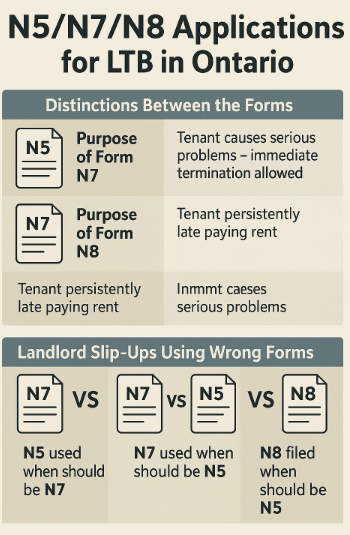
The N7 Notice ) is used to let a tenant know that a landlord wants to end their tenancy because of severe misconduct, safety risks, or major property damage. Unlike other forms (such as the N5), the N7 cannot be canceled or voided by the tenant fixing the issue or stopping the behavior..
This Notice and associated application to the Board ca only be used for specific, serious actions caused by the tenant or their guests:
- Safety Impairment: putting the safety of other people in the building at risk.
- Willful Damage: Deliberately or intentionally damaging the property.
- Serious Damage from Misuse: Using a residential home for unauthorized activities that cause or threaten major structural damage.
- Interference: Substantially interfering with the landlord's or other tenants' reasonable enjoyment in their residence, available only if the landlord lives in the same building with three or fewer units.
Further uses of an N8 Notice
Eal;ier this page discussed the use of an N8 Notice for persistent late rent payments. There are two other uses for the N8 form, as follows:
- The tenant's loss of subsidized housing eligibility: The tenant no longer qualifies to live in public or subsidized housing units. or,
- When the housing was provided as a part of a tenant's employment and said employment has now ended.
Not an immediate eviction
The correct notice must be given, being 60 days for a monthly tenency or 28 days for a daily or weekly tenant. The Landlord and Tenant Board will review the whole process. In respect of subsidized housing they look at the payment history, earnings declarations, and other relevant information.
In both cases, the tenant is only legally required to move if the landlord files the L2 application with the Landlord and Tenant Board and an adjudicator issues a formal eviction order after a hearing.