
Employment Standards Exemptions
ESA rules:
The Ontario Employment Standards Act, 2000 does not apply to certain categories of workers because the Ontario Legislature chose to remove them from some or all parts of the Act, usually on the basis that their work is already regulated by a different professional or sector-specific regime, or because their work patterns make the ordinary rules impractical.
The main exemptions are set out in Employment Standards Act, 2000, S.O. 2000, c. 41 and O. Reg. 285/01, especially ss. 2, 4, 8, 11, 12, 13, 14, 15, 16, 17, 18, 19, 23, 24, 27, and 28.
What this means is that some workers are fully exempt from Parts VII–XI, while others are only exempt from specific parts such as hours of work, overtime, minimum wage, public holidays, or vacation pay. The regulation has a long list of occupations.
What are these parts?
- Part VII - Hours of work and eating periods.
- Part VII.01 - Disconnecting from work (a new rule implemented by the Working for Workers Act).
- Part VII.1 - The minimum three work rule, when the worker's work day has been altered.
- Part VIII - Overtime pay.
- Part IX - Minimum wage.
- Part X - Public holidays.
- Part XI - Vacation with pay.
Take a look at the following chart to see whether it may apply to you:
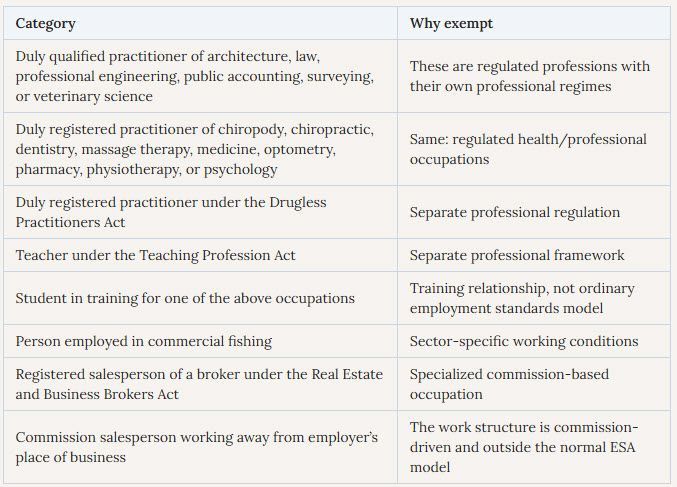
Section. 2(2) of the Act provides a broader farm-related exemption for persons employed on a farm whose employment is directly related to the primary production of specified agricultural products.
Are you one of the categories of workers who are exempt from specific hours of work / eating periods:
- firefighters;
- supervisory or managerial employees who occasionally do non-managerial work;
- fishing or hunting guides;
- construction employees;
- superintendents, janitors, or caretakers of residential buildings who live in the building;
- embalmers and funeral directors.
- landscape gardeners;
- workers installing and maintaining swimming pools;
- workers whose employment is directly related to certain horticultural/farm activities; and
- information technology professionals
There are obvious reasons why such excemptions exist - a fire fighter cannot simply down tools for lunch. they eat when they can. The reason this policy is here is mainly that these occupations involve irregular hours, emergency work, on-site presence, or professional autonomy that does not fit the standard daily and weekly hours rules. Further people working in those sectors are aware of their work environment. Many of these jobs, for example installing swimming pool liners cannot be put down once started.
Workers exempt from overtime pay, Under s. 8, Part VIII does not apply:
- firefighters;
- supervisory or managerial employees in the limited sense described;
- fishing or hunting guides;
- landscape gardeners and pool installers/maintainers;
- certain horticultural workers;
- students instructing or supervising children;
- students at a camp for children;
- students in charitable recreational programs;
- residential building superintendents/janitors/caretakers who reside in the building;
- taxi cab drivers, they are normally paid per ride, and will end their shift when returning to base after their last ride;
- ambulance drivers, helpers, and first-aid attendants on an ambulance;
- information technology professionals.
There are also special overtime rules for certain sectors.
Part IX covers those who are exempt from minimum wage. These include:
- students in charitable recreational programs directly connected to the program;
- students employed to instruct or supervise children;
- students employed at a camp for children; and
- superintendents, janitors, or caretakers of residential buildings who reside in the building.
Pleas understant that there are also special minimum wage rules for some categories, such as homeworkers, hunting/fishing guides, commission automobile sales workers, and domestic workers.
Part X, Public holidays, does not apply to a number of sector-specific groups, including:
- firefighters;
- fishing or hunting guides;
- landscape gardeners and pool installers/maintainers;
- certain horticultural workers;
- students in child-supervision roles;
- camp students;
- students in charitable recreational programs;
- resident residential building caretakers;
- taxi cab drivers;
- seasonal employees in hotels, motels, tourist resorts, restaurants, or taverns who are provided room and board;
- employees who may choose whether to work when requested.
The exemption exists for fire fighters because the job involves continuous emergency work. Firefighters may be required to work on statutory holidays, so the ordinary public-holiday scheme—designed around employees receiving the day off or receiving statutory holiday pay and substitute arrangements—is not well suited to their shift-based operational requirements. The same is true for the other categories identified.
Because s. 2 removes certain occupations from Parts VII through XI, those workers are also exempt from vacation-related and termination-related standards in those parts.
Why these exemptions exist
The reasons vary, but they usually fall into a few themes:
- Professional self-regulation. Many licensed professions are governed by separate statutes and professional bodies.
- Sector-specific work patterns - Construction, trucking, road building, farming, hospitality, and seasonal industries have irregular or project-based schedules.
- Emergency or public-safety work - Firefighters, ambulance staff, and similar jobs often require availability beyond normal hours rules.
- Managerial autonomy - Supervisory and managerial workers are treated differently because they are not in the same position as ordinary hourly workers.
- Student, trainee, or special-purpose roles - Some roles are tied to training or limited program participation rather than ordinary employment.
Legislative choice to create tailored rules instead of blanket coverage. In some industries the Act does not fully exempt workers, but substitutes special thresholds or rules tailored to the sector. This is why you need to consult Invictus Legal LLP.
Please be aware that exemptions are occupation-specific. The worker must actually be employed as a duly qualified practitioner, holding a title alone may not be enough for this rule to apply. However, the exemption is not universal across all ESA protections. This regulation also creates other occupation-based exemptions, but different parts of the Act treat various occupations differently. For example, some workers are exempt from overtime but not necessarily from minimum wage, and some are subject to special rules instead of the subject of a full exemption.
Whenever there is a dispute about whether an individual falls within the listed occupation, the exemption is construed narrowly.
Have a look at the Spin Legal video by Angela Browne and Peter Giblett on the Spin Legal episode of July 28th, 2026 Episode
#128 with Angela Browne and Peter Giblett, partners at Invictus Legal LLP. Tonight the topic of discussion is "who is exempt from parts of Employment Standards and why?"
#weareinvictus
#EmploymentLaw
#WorkplaceRights
#EmploymentStandards
#SpinLegal
Spin Legal